

Your Complete Eye Care Guide: Symptoms, Eye Tests, Treatments, and When to Seek Help
Your Complete Eye Care Guide: Symptoms, Eye Tests, Treatments, and When to Seek Help
Taking care of your eyes can feel confusing when you are not sure what a symptom means, what test you may need, or whether a treatment is urgent. Many patients wait because they hope the problem will settle on its own, or because they do not know where to begin. This complete eye care guide is meant to help you understand things in a simple, clear way so you can feel more confident about when to seek help and what kind of care may be right for you. Many eye conditions can begin with very few symptoms, which is one reason regular attention to eye health matters.
Why regular eye care should not be delayed?
A lot of people think eye care is only needed when vision becomes badly blurred or painful. But in real life, that is not always how eye problems begin. Some conditions may develop slowly, and some may not cause obvious warning signs in the early stage. That is why patients should not think of eye care only as something for emergencies. Regular eye attention, timely evaluation, and the right guidance can make a real difference in protecting long-term vision.
It is also important to remember that eye care is not only about treatment. It is also about understanding your eyes, tracking changes, and making informed decisions early. Even if a symptom turns out to be minor, getting clarity can reduce stress and help you avoid unnecessary delay.
Common eye problems patients often ignore at first
Many eye concerns do not look serious at the beginning. A person may notice occasional blur, mild discomfort, watering, dryness, headaches while reading, or difficulty seeing clearly in certain situations. Because these symptoms can come and go, patients often ignore them for weeks or months.
Blurred or cloudy vision is one of the most common reasons people finally decide to get their eyes checked. In some cases, the issue may be related to a refractive change, but in other cases it may need closer evaluation. Similarly, if you notice pressure-like discomfort, difficulty with side vision, or changes that seem gradual but persistent, it is worth getting examined instead of assuming it is only tiredness.
Some symptoms deserve faster attention. New flashes, sudden floaters, a dark curtain-like shadow, or sudden changes in vision can be warning signs that should not be ignored. Sudden symptoms like these can sometimes be associated with retinal problems and should be assessed promptly.
Patients also commonly ignore dryness, burning, redness, gritty sensation, or irritation because they assume it is only screen strain or dust. Sometimes that may be true, but sometimes the problem needs proper clinical assessment. The same applies to eye injury, eyelid-related changes, double vision, or visible eye misalignment. The safest approach is simple: if the symptom is persistent, worsening, sudden, or affecting daily life, it deserves proper eye care evaluation.
What happens during an eye checkup?
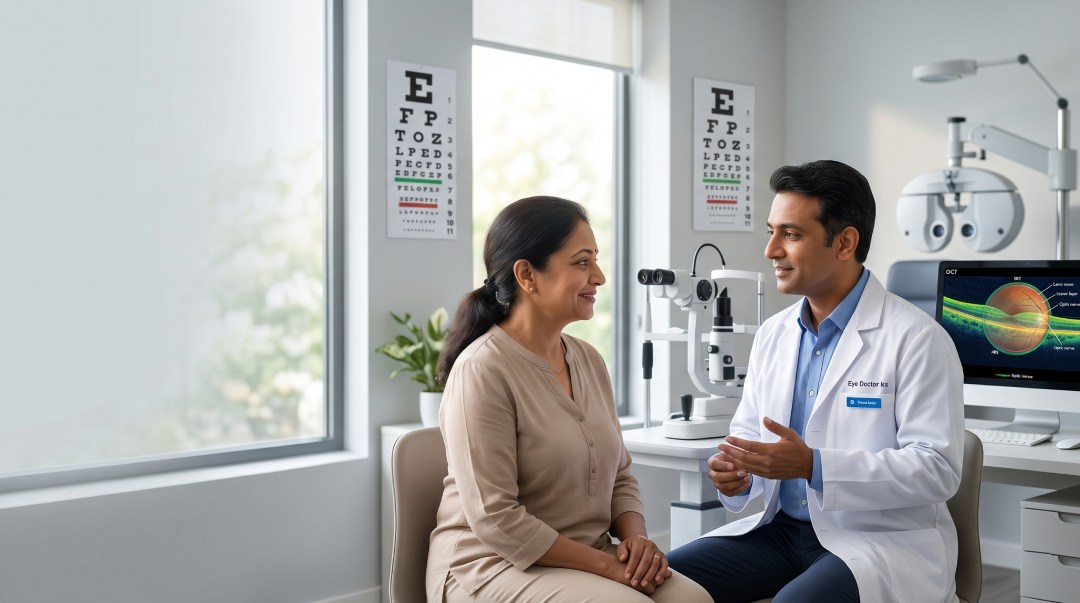
One reason patients delay eye care is fear of the unknown. They are not sure what will happen during a checkup, whether it will be uncomfortable, or whether they will immediately be told they need treatment. In most cases, an eye checkup is designed to understand your symptoms, evaluate your vision, and examine the health of different parts of the eye so the doctor can guide you properly.
A checkup may begin with questions about what you are experiencing, how long it has been happening, whether the problem is in one eye or both, and whether it is affecting work, reading, driving, or daily comfort. Your vision may be checked first, followed by further evaluation depending on your symptoms.
This is where diagnostic support becomes important. Not every patient needs the same test, and not every complaint leads to the same treatment. A proper checkup helps identify what is actually happening before any decision is made. That is why evaluation should come before assumption, and diagnosis should come before treatment. Regular comprehensive eye exams are also important because some eye diseases can be detected early only through examination.
Eye tests your doctor may recommend and why they matter
Many patients feel nervous when they hear the word “test,” but eye diagnostic tests are not something to fear. These tests are usually done to help the doctor understand your condition more accurately. In simple words, they provide a clearer picture of how your eyes are functioning and whether there are changes that need attention.
You may hear names like OCT, keratometry, or gonioscopy. These names can sound technical, but their purpose is straightforward: to support the doctor with more precise information. Some tests are used to look at deeper eye structures, some help assess the cornea, and some help evaluate glaucoma-related concerns. The goal is not to make things complicated for the patient. The goal is to make diagnosis more accurate.
This is one of the most important parts of quality eye care. When diagnosis is clear, treatment becomes more appropriate. It also helps patients understand why a certain approach is being recommended instead of feeling like decisions are being made without explanation.
When laser treatment may be advised?
The word “laser” often makes patients anxious, but laser treatment is not something every patient needs, and it is not advised casually. Doctors recommend laser care only when it is appropriate for a specific condition and when it supports better management of that problem.
Depending on the diagnosis, some patients may be advised procedures such as YAG laser or retinal laser. The important thing for patients to understand is that laser treatment is not a general solution for every eye complaint. It is a targeted approach, used when the doctor believes it is the right option for that particular eye condition.
That is why it is better not to panic if laser is mentioned, and also not to assume you need laser treatment just because you have read about it online. The correct approach is to let the diagnosis guide the treatment. Once patients understand why a laser procedure is being recommended, the treatment journey often feels much less frightening and much more manageable.
Why the right diagnosis should come before treatment?
Many people search online for a treatment before they even know the exact problem. This is understandable, because when your eyes are troubling you, you want a quick answer. But in eye care, the same symptom can sometimes have different causes. Blurred vision, for example, does not always point to one single condition. Redness, watering, or discomfort can also happen for different reasons.
That is why the right diagnosis matters so much. Good eye care is not only about offering treatment. It is about offering the right treatment for the right reason at the right time. When patients are properly evaluated first, unnecessary fear is reduced, confusion becomes less, and the treatment plan becomes more trustworthy.
This is also why experienced clinical judgment and good diagnostic support work best together. Patients feel more reassured when they understand that treatment is being recommended on the basis of findings, not guesswork.
Why expert guidance matters in eye care?
For many patients, trust matters just as much as treatment. When you are worried about your vision, you want to know who is guiding your care, what kind of approach the hospital follows, and whether the advice is being given with both skill and responsibility.
Expert guidance matters because eye care is not only a technical process. It is also a human one. Patients need explanations in simple language. They need reassurance when they are afraid. They need clarity when they are confused. And they need confidence that decisions are being made carefully, ethically, and in their long-term interest.
That is why the right eye hospital is not only defined by treatments and technology. It is also defined by its doctors, its values, its discipline, and the way it speaks to patients. Good care is built not only on diagnosis and treatment, but also on trust, responsibility, and patient-centered guidance.
Simple habits that support long-term eye health
While not every eye condition can be prevented, there are daily habits that can support overall eye health. Screen breaks, regular checkups, healthy food choices, protection from UV exposure, avoiding smoking, and proper contact lens hygiene all play a role in reducing avoidable risks. These habits do not replace professional evaluation when symptoms appear, but they do support long-term eye care in a meaningful way.
If you spend long hours on screens, it helps to take regular visual breaks and blink more often. If you wear contact lenses, careful hygiene matters. And if you have health conditions such as diabetes or blood pressure concerns, eye checkups become even more important because overall health and eye health are closely connected.
When should you contact an eye hospital?
You should not wait too long if you are experiencing persistent blur, recurring discomfort, redness that does not settle, symptoms that are affecting daily life, or any sudden change in vision. And if symptoms feel urgent, unusual, or alarming, it is always safer to seek proper eye care guidance instead of waiting in uncertainty.
Sudden flashes, new floaters, a shadow in the field of vision, or rapid vision change deserve prompt attention. Eye injury also deserves quick evaluation. Even if the final issue turns out to be manageable, early action gives you the best chance of clarity and timely care.
Final Thoughts
If you have ever felt confused about symptoms, unsure about eye tests, or worried about treatment, you are not alone. Most patients simply want clear answers, honest guidance, and the confidence that they are doing the right thing for their vision. That is exactly why understanding the basics of eye care matters.
The good news is that you do not need to understand everything at once. You only need to take the next right step. If something about your eyes does not feel normal, if symptoms are staying longer than expected, or if you just want clarity, seeking proper eye care guidance is always a wise decision. Early attention, accurate diagnosis, and trusted support can make your path forward much easier.