

Why High Myopia in Childhood Can Become a Serious Long-Term Threat
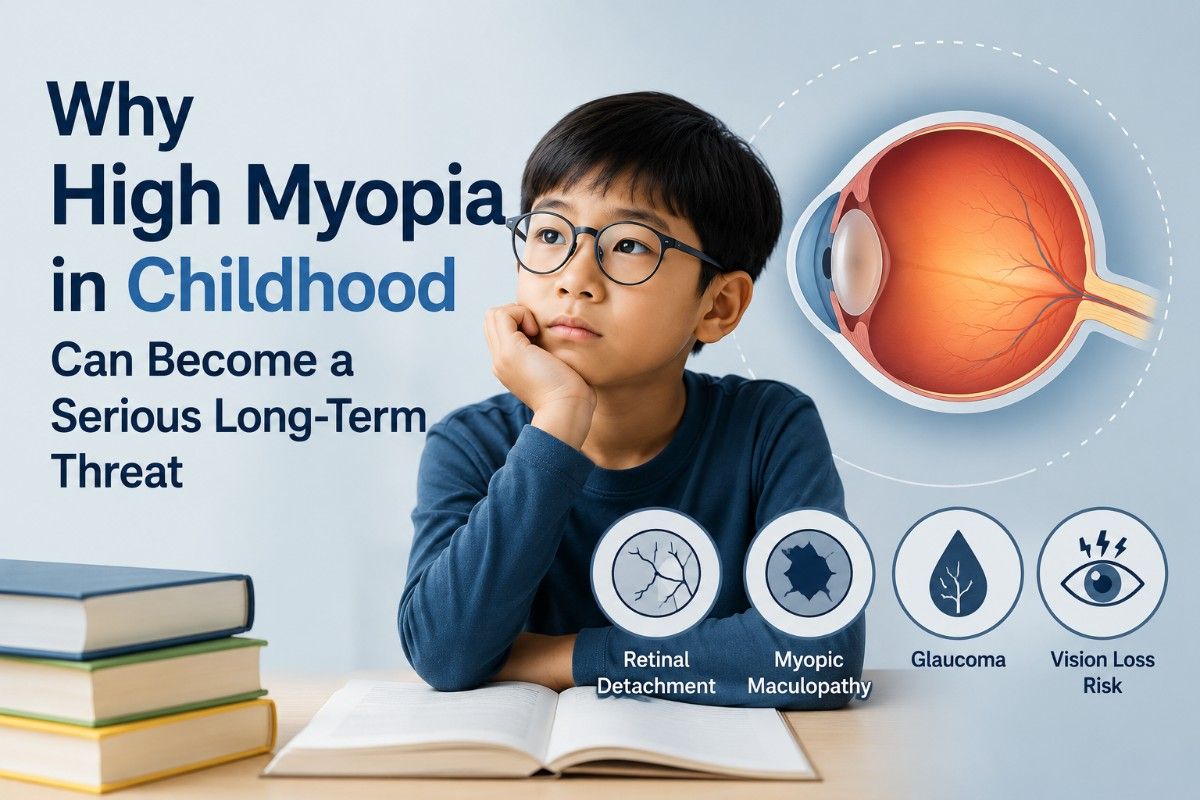
The Myth of Harmless Nearsightedness
For years, childhood glasses simply acted as a highly effective tool. You would get a prescription, and it would fix the blur. However, that once-established dynamic is now officially dead. We have officially entered the Epidemic of Myopia, where severe refractive errors do much more than just require thicker lenses. Recognizing these myopia causes stops irreversible harm. It is a direct pathway to high myopia at a young age. They are now actively stretching the retina, increasing glaucoma risks, and executing complex macular changes entirely on their own. Poor vision is no longer just a minor inconvenience. It is rapidly becoming a leading cause of blindness.
How Severe Myopia Creates Hidden Ocular Damage
The latest breakthroughs prove that retinal risk now scales exactly like physical disease. Modern myopia causes do not require advanced aging or rigid genetic disorders. Instead, they use excessive axial elongation to divide and conquer ocular health autonomously. These structural myopia causes dictate the risk. This physical shift guarantees high myopia at a young age.
Here is exactly how these pathological shifts function today:
- The Elongation: A core biological trigger evaluates a blurry image and independently formulates a continuous eye growth strategy.
- The Thinning: The system stretches the retina, explores different structural weaknesses, and systematically causes micro-tears without human intervention.
- The Complication: Finally, the eye compiles its structural damage, analyzes the resulting strain, and drafts a permanent retinal detachment. Remarkably, some advanced cases of childhood myopia have already successfully bypassed standard clinical safety thresholds.
The Internal Progression of Structural Eye Risk
Linear growth expectations are completely outdated. The true secret behind treating high myopia at a young age is the profound ability to stop multiple degenerative processes simultaneously. To achieve this massive scale, compromised eyes rely heavily on continuous structural loops. Unchecked myopia causes weaken the sclera. This biomechanical stress defines high myopia at a young age.
Instead of waiting for one single growth spurt to finish, these eyes use complex biomechanical methodologies. This means they actively thin, stretch, weaken, and distort sensitive tissues in parallel. If a specific structural support fails, the tissue instantly pivots. It learns from the stress and immediately launches a new microscopic tear. Consequently, these structural elongation loops perfectly mirror the absolutely most dangerous pathological pipelines. But crucially, they operate at a speed and scale no standard eye could ever match. No manual lens update can realistically keep up with that physiological output.
Why Early Monitoring Changes Everything
This radical shift extends far beyond general checkups. It is already reshaping how real doctors make clinical decisions. For concerned parents, pediatric ophthalmologists, and public health advocates, understanding how to prevent myopia is about to completely redefine vision management. Controlling these myopia causes alters clinical outcomes. It halts the rapid onset of high myopia at a young age.
- Risk Assessment: Medical teams can actively synthesize thousands of eye scans. They can test multiple treatment options in parallel. They can then deliver a finalized medical strategy while you sleep.
- Disease Prevention: Eye specialists can aggressively use these treatments to test slowing methods continuously. They can run eye drop protocols at scale. They can also discover retinal stress in real time, before patients ever notice it.
- Long-term Strategy: Vision clinics can seamlessly deploy interventions to analyze growth trends in depth. These protocols can automatically generate massive, data-backed management clusters. They turn raw scans into publish-ready ideas on how to reduce myopia.
A New Approach to Managing Vision Risk Early
The barrier to entry for permanent vision loss has fundamentally dropped to zero. Any child with access to modern environmental risks can now run elongation loops that once required decades of strain. Targeting underlying myopia causes changes in the future. We can finally outsmart high myopia at a young age. Families that still rely on stronger glasses to manually fix the issue will fall behind. Those that only prompt basic vision screenings will also be severely outpaced. It is time to aggressively audit your current medical workflows. Start integrating advanced myopia control into your daily operations today. Embrace the immediate shift from simple corrections to full disease management, and let your specialists rapidly protect your child's vision
Disclaimer:
This article discusses risks associated with high myopia at a young age, including possible long-term eye complications. It is not intended to diagnose disease or replace individualized medical care. Risk levels vary by child, and regular monitoring by a pediatric eye specialist is essential.
Efforts are made to ensure that the information and content are correct and up to date; however, medical information can change. Dr. D.B. Sarkar Eye Hospital and its staff do not assume responsibility for any action taken as a result of this article alone. Make sure to see our eye experts in Cooch Behar for personalised eye care advice.